2 дня
О сайте


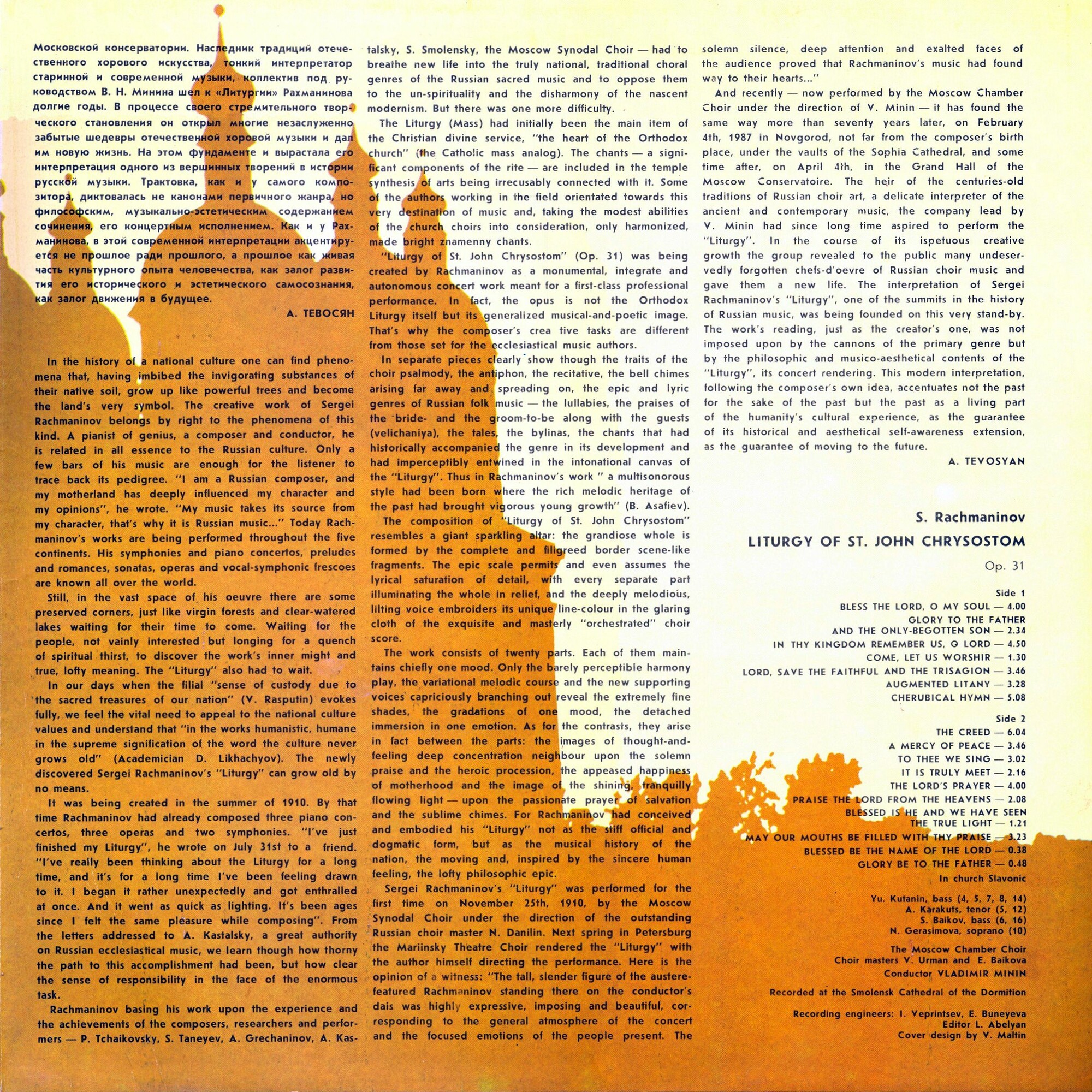
In the history of a national culture one can find phenomena that, having imbibed the invigorating substances of their native soil, grow up like powerful trees and become the land's very symbol. The creative work of Sergei Rachmaninov belongs by right to the phenomena of this kind. A pianist of genius, a composer and conductor, he is related in all essence to the Russian culture. Only a few bars of his music are enough for the listener to trace back its pedigree. "I am a Russian composer, and my motherland has deeply influenced my character and my opinions", he wrote. "My music takes its source from my character, that's why it is Russian music..." Today Rachmaninov's works are being performed throughout the five continents. His symphonies and piano concertos, preludes and romances, sonatas, operas and vocal-symphonic frescoes are known all over the world.
Still, in the vast space of his oeuvre there are some preserved corners, just like virgin forests and clear-watered lakes waiting for their time to come. Waiting for the people, not vainly interested but longing for a quench of spiritual thirst, to discover the work's inner might and true, lofty meaning. The "Liturgy" also had to wait.
In our days when the filial "sense of custody due to the sacred treasures of our nation" (V. Rasputin) evokes fully, we feel the vital need to appeal to the national culture values and understand that "in the works humanistic, humane in the supreme signification of the word the culture never grows old" (Academician D. Likhachyov). The newly discovered Sergei Rachmaninov's "Liturgy" can grow old by no means.
It was being created in the summer of 1910. By that time Rachmaninov had already composed three piano concertos, three operas and two symphonies. "I've just finished my Liturgy", he wrote on July 31st to a friend. "I've really been thinking about the Liturgy for a long time, and it's for a long time I've been feeling drawn to it. I began it rather unexpectedly and got enthralled at once. And it went as quick as lighting. It's been ages since I felt the same pleasure while composing". From the letters addressed to A. Kastalsky, a great authority on Russian ecclesiastical music, we learn though how thorny the path to this accomplishment had been, but how clear the sense of responsibility In the face of the enormous task.
Rachmaninov basing his work upon the experience and the achievements of the composers, researchers and performers — P. Tchaikovsky, S. Taneyev, A. Grechaninov, A. Kastalsky, S. Smolensky, the Moscow Synodal Choir — had to breathe new life into the truly national, traditional choral genres of the Russian sacred music and to oppose them to the un-spirituality and the disharmony of the nascent modernism. But there was one more difficulty.
The Liturgy (Mass) had initially been the main item of the Christian divine service, "the heart of the Orthodox church" (the Catholic mass analog). The chants—a significant components of the rite — are included in the temple synthesis of arts being irrecusably connected with it. Some of the authors working in the field orientated towards this very destination of music and, taking the modest abilities of the church choirs into consideration, only harmonized, made bright znamenny chants.
"Liturgy of St. John Chrysostom" (Op. 31) was being created by Rachmaninov as a monumental, integrate and autonomous concert work meant for a first-class professional performance. In fact, the opus is not the Orthodox Liturgy itself but its generalized musical-and-poetic image. That's why the composer's creative tasks are different from those set for the ecclesiastical music authors.
In separate pieces clearly show though the traits of the choir psalmody, the antiphon, the recitative, the bell chimes arising far away and spreading on, the epic and lyric genres of Russian folk music — the lullabies, the praises of the bride- and the groom-to-be along with the guests (velichaniya), the tales, the bylinas, the chants that had historically accompanied the genre in its development and had imperceptibly entwined in the intonational canvas of the "Liturgy". Thus in Rachmaninov's work " a multisonorous style had been born where the rich melodic heritage of the past had brought vigorous young growth" (B. Asafiev).
The composition of "Liturgy of St. John Chrysostom" resembles a giant sparkling altar: the grandiose whole is formed by the complete and filigreed border scene-like fragments. The epic scale permits and even assumes the lyrical saturation of detail, with every separate part illuminating the whole in relief, and the deeply melodious, lilting voice embroiders its unique line-colour in the glaring cloth of the exquisite and masterly "orchestrated" choir score.
The work consists of twenty parts. Each of them maintains chiefly one mood. Only the barely perceptible harmony play, the variational melodic course and the new supporting voices capriciously branching out reveal the extremely fine shades, the gradations of one mood, the detached immersion in one emotion. As for the contrasts, they arise in fact between the parts: the images of thought-and-feeling deep concentration neighbour upon the solemn praise and the heroic procession, the appeased happiness of motherhood and the image of the shining, tranquilly flowing light — upon the passionate prayer of salvation and the sublime chimes. For Rachmaninov had conceived and embodied his "Liturgy" not as the stiff official and dogmatic form, but as the musical history of the nation, the moving and, inspired by the sincere human feeling, the lofty philosophic epic.
Sergei Rachmaninov's "Liturgy" was performed for the first time on November 25th, 1910, by the Moscow Synodal Choir under the direction of the outstanding Russian choir master N. Danilin. Next spring in Petersburg the Mariinsky Theatre Choir rendered the "Liturgy" with the author himself directing the performance. Here is the opinion of a witness: "The tall, slender figure of the austere-featured Rachmaninov standing there on the conductor's dais was highly expressive, imposing and beautiful, corresponding to the general atmosphere of the concert and the focused emotions of the people present. The
solemn silence, deep attention and exalted faces of the audience proved that Rachmaninov's music had found way to their hearts..."
And recently — now performed by the Moscow Chamber Choir under the direction of V. Minin — it has found the same way more than seventy years later, on February 4th, 1987 in Novgorod, not far from the composer's birth place, under the vaults of the Sophia Cathedral, and some time after, on April 4th, in the Grand Hall of the Moscow Conservatoire. The heir of the centuries-old traditions of Russian choir art, a delicate interpreter of the ancient and contemporary music, the company lead by V. Minin had since long time aspired to perform the "Liturgy". In the course of its ispetuous creative growth the group revealed to the public many undeservedly forgotten chefs-d'oevre of Russian choir music and gave them a new life. The interpretation of Sergei Rachmaninov's "Liturgy", one of the summits in the history of Russian music, was being founded on this very stand-by. The work's reading, just as the creator's one, was not imposed upon by the cannons of the primary genre but by the philosophic and musico-aesthetical contents of the "Liturgy", its concert rendering. This modern interpretation, following the composer's own idea, accentuates not the past for the sake of the past but the past as a living part of the humanity's cultural experience, as the guarantee of its historical and aesthetical self-awareness extension, as the guarantee of moving to the future.
A. TEVOSYAN
Still, in the vast space of his oeuvre there are some preserved corners, just like virgin forests and clear-watered lakes waiting for their time to come. Waiting for the people, not vainly interested but longing for a quench of spiritual thirst, to discover the work's inner might and true, lofty meaning. The "Liturgy" also had to wait.
In our days when the filial "sense of custody due to the sacred treasures of our nation" (V. Rasputin) evokes fully, we feel the vital need to appeal to the national culture values and understand that "in the works humanistic, humane in the supreme signification of the word the culture never grows old" (Academician D. Likhachyov). The newly discovered Sergei Rachmaninov's "Liturgy" can grow old by no means.
It was being created in the summer of 1910. By that time Rachmaninov had already composed three piano concertos, three operas and two symphonies. "I've just finished my Liturgy", he wrote on July 31st to a friend. "I've really been thinking about the Liturgy for a long time, and it's for a long time I've been feeling drawn to it. I began it rather unexpectedly and got enthralled at once. And it went as quick as lighting. It's been ages since I felt the same pleasure while composing". From the letters addressed to A. Kastalsky, a great authority on Russian ecclesiastical music, we learn though how thorny the path to this accomplishment had been, but how clear the sense of responsibility In the face of the enormous task.
Rachmaninov basing his work upon the experience and the achievements of the composers, researchers and performers — P. Tchaikovsky, S. Taneyev, A. Grechaninov, A. Kastalsky, S. Smolensky, the Moscow Synodal Choir — had to breathe new life into the truly national, traditional choral genres of the Russian sacred music and to oppose them to the un-spirituality and the disharmony of the nascent modernism. But there was one more difficulty.
The Liturgy (Mass) had initially been the main item of the Christian divine service, "the heart of the Orthodox church" (the Catholic mass analog). The chants—a significant components of the rite — are included in the temple synthesis of arts being irrecusably connected with it. Some of the authors working in the field orientated towards this very destination of music and, taking the modest abilities of the church choirs into consideration, only harmonized, made bright znamenny chants.
"Liturgy of St. John Chrysostom" (Op. 31) was being created by Rachmaninov as a monumental, integrate and autonomous concert work meant for a first-class professional performance. In fact, the opus is not the Orthodox Liturgy itself but its generalized musical-and-poetic image. That's why the composer's creative tasks are different from those set for the ecclesiastical music authors.
In separate pieces clearly show though the traits of the choir psalmody, the antiphon, the recitative, the bell chimes arising far away and spreading on, the epic and lyric genres of Russian folk music — the lullabies, the praises of the bride- and the groom-to-be along with the guests (velichaniya), the tales, the bylinas, the chants that had historically accompanied the genre in its development and had imperceptibly entwined in the intonational canvas of the "Liturgy". Thus in Rachmaninov's work " a multisonorous style had been born where the rich melodic heritage of the past had brought vigorous young growth" (B. Asafiev).
The composition of "Liturgy of St. John Chrysostom" resembles a giant sparkling altar: the grandiose whole is formed by the complete and filigreed border scene-like fragments. The epic scale permits and even assumes the lyrical saturation of detail, with every separate part illuminating the whole in relief, and the deeply melodious, lilting voice embroiders its unique line-colour in the glaring cloth of the exquisite and masterly "orchestrated" choir score.
The work consists of twenty parts. Each of them maintains chiefly one mood. Only the barely perceptible harmony play, the variational melodic course and the new supporting voices capriciously branching out reveal the extremely fine shades, the gradations of one mood, the detached immersion in one emotion. As for the contrasts, they arise in fact between the parts: the images of thought-and-feeling deep concentration neighbour upon the solemn praise and the heroic procession, the appeased happiness of motherhood and the image of the shining, tranquilly flowing light — upon the passionate prayer of salvation and the sublime chimes. For Rachmaninov had conceived and embodied his "Liturgy" not as the stiff official and dogmatic form, but as the musical history of the nation, the moving and, inspired by the sincere human feeling, the lofty philosophic epic.
Sergei Rachmaninov's "Liturgy" was performed for the first time on November 25th, 1910, by the Moscow Synodal Choir under the direction of the outstanding Russian choir master N. Danilin. Next spring in Petersburg the Mariinsky Theatre Choir rendered the "Liturgy" with the author himself directing the performance. Here is the opinion of a witness: "The tall, slender figure of the austere-featured Rachmaninov standing there on the conductor's dais was highly expressive, imposing and beautiful, corresponding to the general atmosphere of the concert and the focused emotions of the people present. The
solemn silence, deep attention and exalted faces of the audience proved that Rachmaninov's music had found way to their hearts..."
And recently — now performed by the Moscow Chamber Choir under the direction of V. Minin — it has found the same way more than seventy years later, on February 4th, 1987 in Novgorod, not far from the composer's birth place, under the vaults of the Sophia Cathedral, and some time after, on April 4th, in the Grand Hall of the Moscow Conservatoire. The heir of the centuries-old traditions of Russian choir art, a delicate interpreter of the ancient and contemporary music, the company lead by V. Minin had since long time aspired to perform the "Liturgy". In the course of its ispetuous creative growth the group revealed to the public many undeservedly forgotten chefs-d'oevre of Russian choir music and gave them a new life. The interpretation of Sergei Rachmaninov's "Liturgy", one of the summits in the history of Russian music, was being founded on this very stand-by. The work's reading, just as the creator's one, was not imposed upon by the cannons of the primary genre but by the philosophic and musico-aesthetical contents of the "Liturgy", its concert rendering. This modern interpretation, following the composer's own idea, accentuates not the past for the sake of the past but the past as a living part of the humanity's cultural experience, as the guarantee of its historical and aesthetical self-awareness extension, as the guarantee of moving to the future.
A. TEVOSYAN